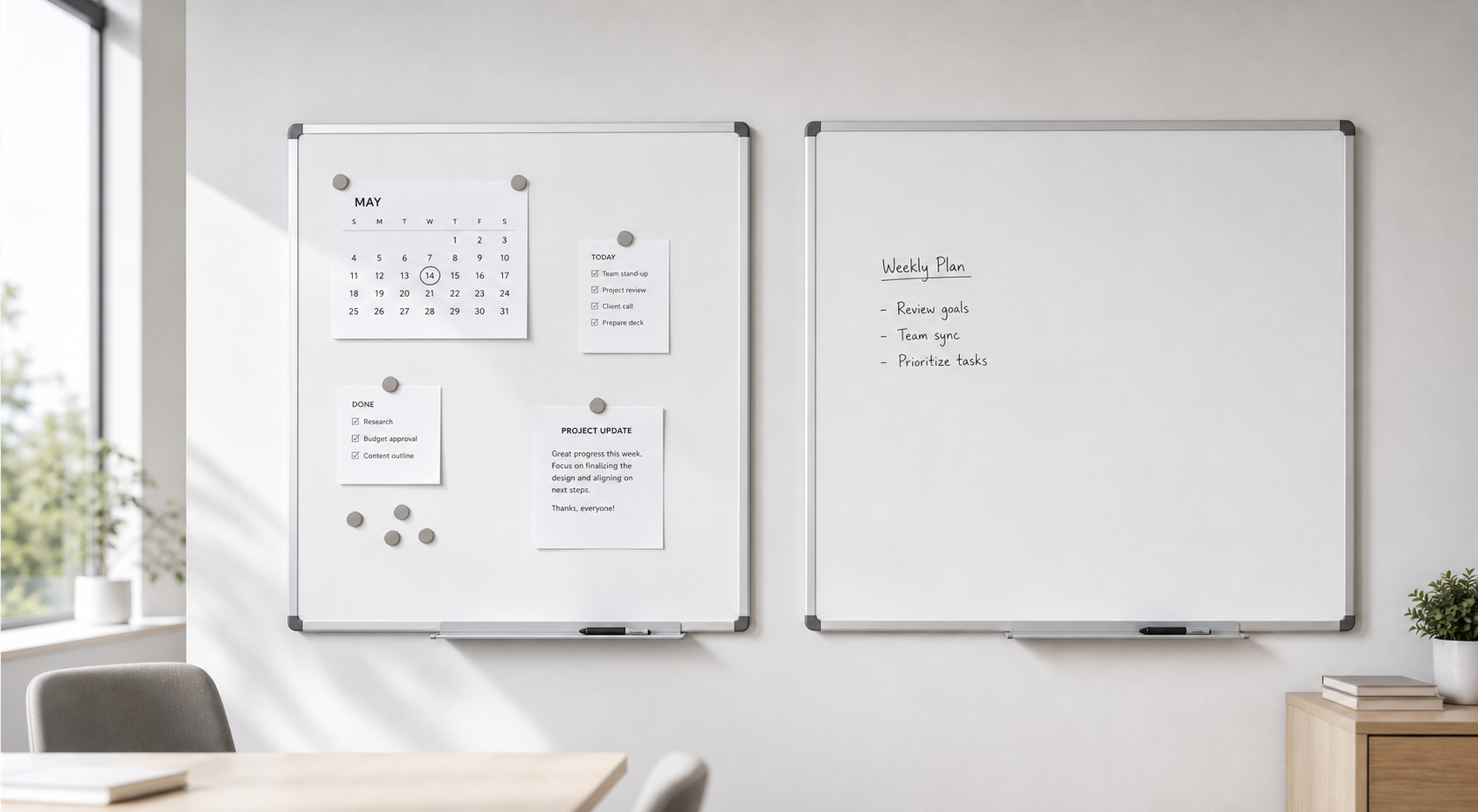
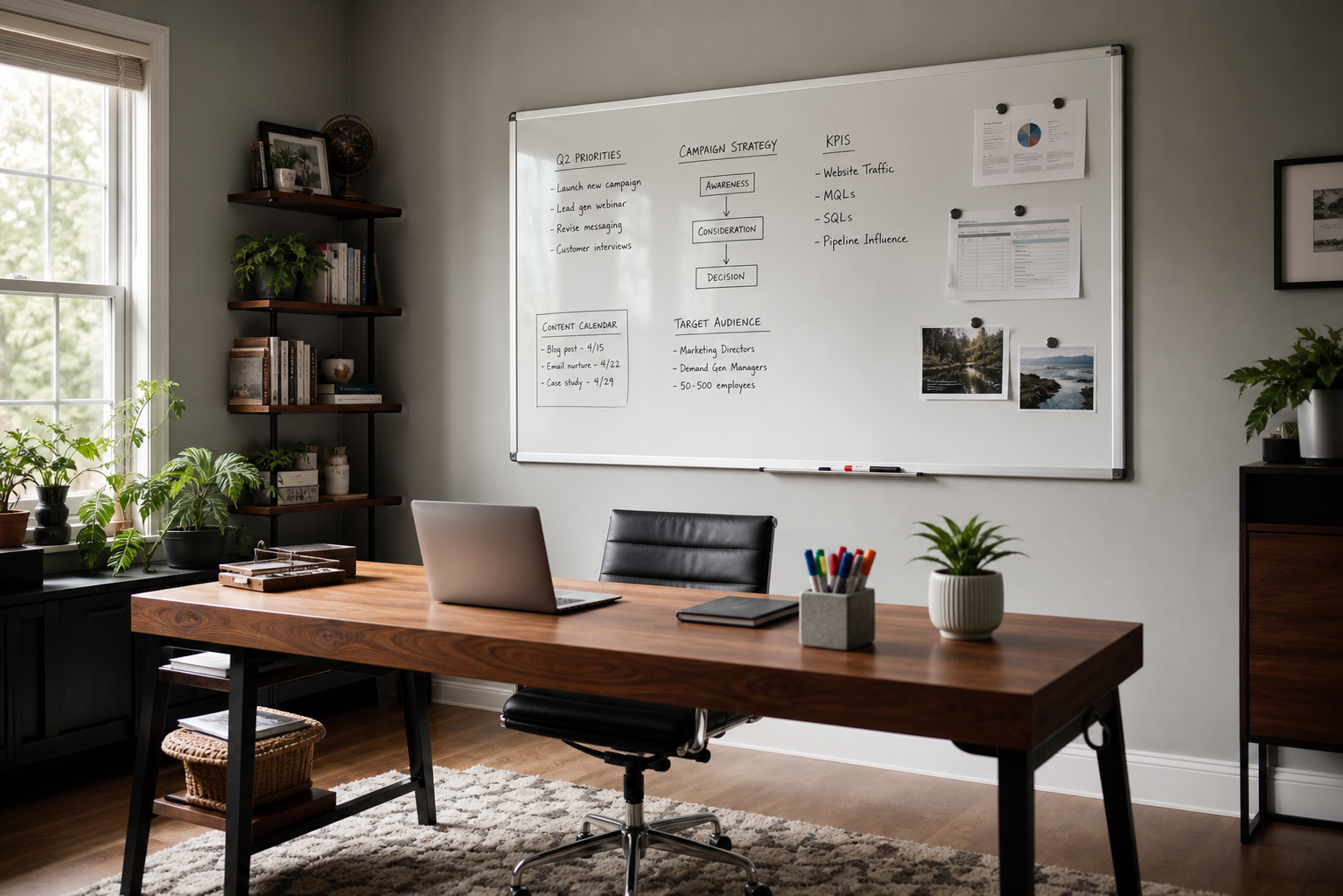
Whiteboard wallpaper and traditional whiteboards both provide reusable dry erase writing surfaces, but they work differently in a space. A traditional whiteboard is a finished board mounted to the wall, while whiteboard wallpaper is applied directly to a wall to create a writable surface.
The better choice depends on how much writing space you need, how permanent the installation should be, whether you need magnetic functionality, and how the surface will be used.
What is the Difference Between Whiteboard Wallpaper and Traditional Whiteboards?
The main difference is how the writing surface is installed and used.
A traditional whiteboard is a finished board mounted to the wall. It can have a porcelain steel, glass, or melamine surface and may be magnetic or non-magnetic.
Whiteboard wallpaper, also called dry erase wallpaper or dry erase wall covering, is applied directly to a wall or other suitable surface. It creates a writable area without the fixed dimensions of a traditional board. MyWhiteboards offers magnetic-receptive and non-magnetic dry erase wall coverings, including peel-and-stick options.
|
Feature
|
Whiteboard Wallpaper
|
Traditional Whiteboard
|
|
Writing surface
|
Yes
|
Yes
|
|
Covers large wall areas
|
Yes
|
Limited by board size
|
|
Peel-and-stick options
|
Available
|
No
|
|
Magnetic options
|
Available in select products
|
Widely available
|
|
Framed appearance
|
Usually no
|
Often yes
|
|
Installation
|
Applied to wall
|
Mounted to wall
|
|
Best for
|
Large collaborative surfaces
|
Defined writing areas
|
Tip: Choose whiteboard wallpaper when you want to maximize writable wall space. Choose a traditional whiteboard when you prefer a standalone board with a defined size, frame, and construction.
When is Whiteboard Wallpaper a Better Choice?
Whiteboard wallpaper makes the most sense when a standard board does not provide enough usable writing space. It can be a practical option for:
- Large meeting and collaboration areas.
- Classrooms and training rooms.
- Offices with limited floor space.
- Project planning walls.
- Creative studios.
- Manufacturing and workflow areas.
- Walls that need continuous dry erase coverage.
Dry erase wallpaper can cover a larger section of a wall than a single framed board. Some wall coverings are also available in continuous rolls for larger applications.
What are the Advantages of Whiteboard Wallpaper?
The main advantage is the ability to use more of the existing wall as a writing surface. Other potential benefits include:
- Creates a continuous writable area.
- Uses existing wall space without a framed board.
- Available in magnetic-receptive versions.
- Peel-and-stick options are available.
- Can be used to resurface some existing writing surfaces.
The right product still depends on the wall, installation method, and intended use. Some wallpaper products also support magnetic use or projection, depending on the specific surface.
View: Full-Height & Wall-Sized Whiteboards for Maximum Writing Space
When is a Traditional Whiteboard the Better Choice?
A traditional whiteboard is often the better option when you need a defined, purpose-built writing surface rather than an entire writable wall. Traditional boards can work well for:
- Individual offices.
- Small meeting rooms.
- Classrooms with a designated teaching board.
- Home offices.
- Conference rooms.
- Areas where a framed board fits the existing layout.
They also provide more control over the board's construction and features. Depending on the product, you can choose surfaces such as porcelain steel, glass, or melamine, along with magnetic or non-magnetic options.
For a space that only needs a defined writing area, installing a full wall covering may provide more surface than necessary.
Is Whiteboard Wallpaper as Good as a Traditional Whiteboard?
It can be, but the comparison depends on the product and application.
A properly specified whiteboard wallpaper can provide a durable dry erase writing surface, but it is not simply a traditional whiteboard without a frame. The materials, installation method, surface finish, and intended use are different.
Traditional whiteboards may offer advantages when you want:
- A rigid writing surface.
- A specific board size.
- A frame or finished edge.
- A freestanding or mobile option.
- A heavy-duty magnetic surface.
Whiteboard wallpaper may be preferable when you need:
- Maximum writable wall area.
- A continuous surface.
- A retrofit or resurfacing solution.
- Flexible coverage for larger walls.
- A less visually segmented writing area.
Durability also depends on the product and how heavily the surface is used. For high-use environments, compare the manufacturer's specifications for writing, cleaning, durability, and warranty before choosing.
Neither format is universally better. The right choice depends on the space, surface requirements, installation conditions, and workload.
Which is Better for Large Walls?
For large writable areas, whiteboard wallpaper generally has the advantage because it is designed to cover walls rather than provide a single fixed-size board.
Traditional whiteboards can also create large writing areas by combining multiple boards or using full-height whiteboard wall systems.
If you want one continuous writable surface, wallpaper can be the more direct approach. If you prefer rigid panels or need a particular board construction, a full-height traditional whiteboard may be more appropriate.
Which is Better for Magnetic Use?
Neither format automatically wins because both magnetic and non-magnetic versions are available.
Some dry erase wallpapers use magnetic-receptive construction that allows magnets or magnetic accessories to attach. Traditional whiteboards are also available with magnetic surfaces, including porcelain steel and some glass boards.
If magnetic use is important, check the product specifications rather than assuming that every whiteboard wallpaper or traditional board is magnetic.
Can Whiteboard Wallpaper Replace a Traditional Whiteboard?
Yes, in many applications. Whiteboard wallpaper can replace a traditional board when the goal is to create a large dry erase area directly on an existing wall. It can also be useful for resurfacing an existing whiteboard or other suitable writing surface.
Traditional whiteboards remain preferable when you need a rigid board with a defined size, frame, mounting system, or specific surface construction.
Some spaces can also use both; a traditional whiteboard for a defined workspace and dry erase wall covering for additional writing area.
Final Thoughts
Whiteboard wallpaper and traditional whiteboards provide the same basic function, a reusable surface for writing. The difference is how that surface fits into the space.
Whiteboard wallpaper is particularly useful when available wall space is the priority. Traditional whiteboards make more sense when you want a defined, rigid board with a specific surface and size.
Before choosing, consider the amount of writing space you need, magnetic requirements, installation conditions, surface type, durability, and how frequently the board will be used.
Frequently Asked Questions (Accordion Format)
Can whiteboard wallpaper be removed?
Some whiteboard wallpaper products are designed with peel-and-stick installation, while others use different adhesive or backing systems. Check the specific product's installation and removal requirements before applying it.
Can whiteboard wallpaper be installed over an existing whiteboard?
Yes, some dry erase wall coverings are designed for resurfacing existing whiteboards or other suitable writing surfaces. The surface must be compatible with the product and properly prepared before installation.
Does whiteboard wallpaper leave a wall completely smooth?
The finished result depends on the condition of the wall beneath it and the installation method. Wall imperfections can affect the appearance of an applied covering, so surface preparation is important.
Can you cut whiteboard wallpaper to fit around outlets and fixtures?
Some wallpaper products can be cut during installation, but the correct method depends on the material and backing. Measure the wall and account for fixtures before ordering or installing the covering.
Is whiteboard wallpaper suitable for classrooms?
Yes. It can be useful in classrooms and training rooms where a larger writing surface is needed. The appropriate product should be selected based on expected use, magnetic requirements, installation conditions, and surface durability.
Related Read: Classroom Dry Erase Boards