Classroom dry erase boards
Student lapboards
Portable lapboards

If your manufacturing floor still relies on fixed whiteboards or printed schedules that go stale by mid-shift, you already know the problem. Lean teams need visual tools that keep pace with changing workflows, not tools that create more waste.
Dry erase wallpaper from My Whiteboards, an OptiMA, Inc. company, gives operations teams a flexible, wall-sized writing surface that adapts to every production cell, huddle area, and Gemba walk station on the floor.
This article explains how dry erase wallpaper supports lean visual workflow management in manufacturing environments. You will learn why wall-sized writable surfaces outperform traditional boards for Kanban tracking, 5S audits, and daily stand-up meetings, and how to plan a rollout that fits your facility.
Lean visual management is a system of visual cues, including boards, signs, color codes, and floor markings, that communicates production status, safety data, and workflow priorities at a glance. The goal is straightforward: make the state of work obvious to anyone who walks by, without requiring a report, a meeting, or a database login.
On a manufacturing floor, this typically includes KPI boards at production lines, Kanban cards tracking work-in-process, 5S audit trackers, and daily management boards where shift supervisors run stand-up meetings. When these tools work well, they compress decision-making and make the enemies of lean, such as waste, variation, and overburden, impossible to ignore.
A 2025 case study published in the Brazilian Journal of Production Engineering found that implementing visual management and process standardization in a manufacturing environment led to an 11.75% reduction in loading time and measurably higher operator engagement.
Standard framed whiteboards serve a purpose, but they come with constraints that work against lean principles. A typical 4-by-6-foot board limits the amount of data you can display. When your team needs to track multiple production lines, shift handoffs, safety metrics, and improvement actions on a single surface, space runs out fast.
Fixed-size boards also make it difficult to reconfigure layouts as your processes change. If you introduce a new cell, move a production line, or add a KPI to your daily huddle, you either cram more information onto an already crowded board or buy another one.
That cycle of replacing and repositioning boards creates the exact kind of waste lean teams are trained to eliminate.
There is also the "wallpaper problem" that lean practitioners describe: when a visual display stays static for too long, operators stop noticing it. A surface that invites frequent, hands-on interaction resists this fade better than a preprinted poster or a rarely updated board.
Dry erase wallpaper turns an entire wall into a live, writable surface. Instead of working inside the edges of a framed board, your team can build layouts that match the actual scale of your operation.
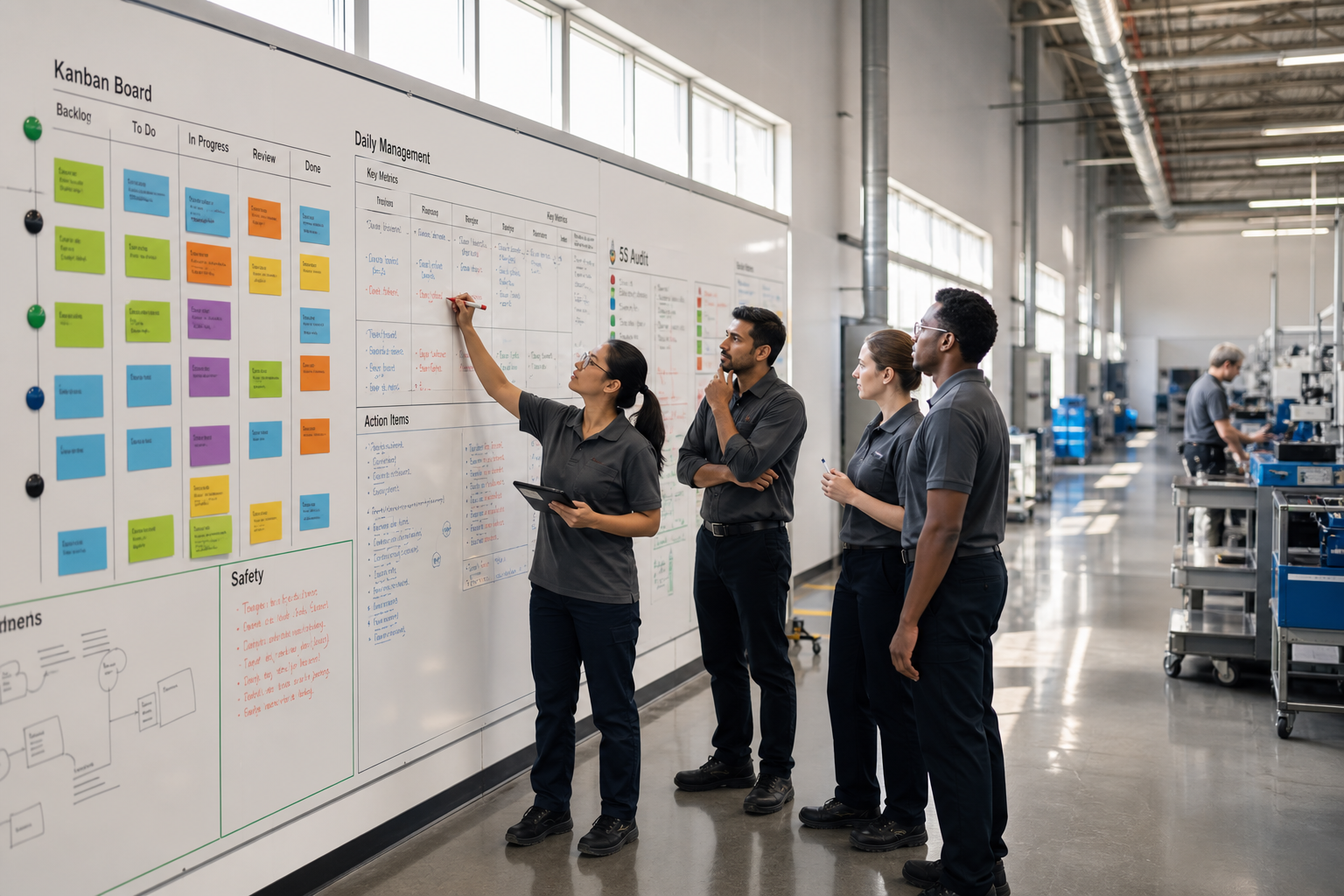
A Kanban board can span eight feet or more. A daily management station can include safety, quality, delivery, and cost tracking side by side without stacking information vertically.
Because the surface is continuous, teams can restructure their visual systems as workflows evolve. Adding a column to a Kanban layout or expanding a root-cause analysis area takes a dry erase marker and thirty seconds, not a purchase order for a new board. That flexibility aligns directly with kaizen: the practice of making small, continuous improvements.
My Whiteboards, an OptiMA, Inc. company, manufactures Opti-Rite® dry erase wallpaper specifically designed for environments like manufacturing floors. The surface is durable enough for daily writing and erasing cycles, and it comes in both magnetic and non-magnetic options so you can pair markers with magnetic indicators for color-coded status tracking.
A wall-sized dry erase surface lets you build a Kanban board scaled to the number of jobs, cells, or stages your line actually runs. You can use colored markers and magnetic cards to move jobs through columns, giving every operator a real-time view of work-in-process without logging into a system.
Lean teams run daily stand-ups around a visual board because physical presence at the board creates shared accountability. With dry erase wallpaper, you can dedicate an entire wall to your daily management station, separating safety, quality, delivery, cost, and morale into distinct zones that are easy to scan from several feet away.
Sort, Set in order, Shine, Standardize, Sustain. Each step benefits from a visible, frequently updated tracking surface. A writable wall next to a production cell lets teams log audit scores, flag deviations, and record corrective actions where the work happens, not in a binder on a supervisor's desk.
When an issue escalates beyond a quick fix, lean teams pull together for a structured problem-solving session. A wall-sized dry erase surface gives you room to map fishbone diagrams, 5-Why chains, and A3 problem reports at full scale, making it easier for the whole team to contribute and see the logic unfold.
Not every dry erase surface performs the same under manufacturing conditions. Opti-Rite® wallpaper from My Whiteboards is manufactured at the company's own facility in Massachusetts and is designed for heavy daily use. The surface resists ghosting, which means it erases cleanly even after weeks of continuous writing, a critical factor when your visual boards are updated every shift.
The peel-and-stick application means installation does not require specialized contractors. Your facilities team can trim the wallpaper to fit any wall dimension, apply it directly, and have a fully functional visual management surface ready the same day. That speed matters when you are rolling out lean tools across multiple production areas.
For teams that use magnetic indicators, colored magnets, or custom printed overlays, the magnetic receptive version of Opti-Rite® wallpaper provides a dual-function surface. You write on it with markers and attach magnetic cards, status dials, or job tickets. One wall handles both functions without needing separate boards.
A common planning mistake in manufacturing settings is treating every wall the same. The visual management needs of a packaging line differ from those of a CNC cell or a shipping dock. Before you order material, walk each area and ask the team what information they need visible at point of use.
Start by mapping your visual management stations. Identify where daily huddles happen, where Kanban boards are needed, and where 5S audit tracking should live. Measure those walls, then plan your Opti-Rite® wallpaper cuts accordingly.
Pro Tip: Begin with one or two high-traffic areas where the impact of better visual tools will be immediately felt, such as a bottleneck cell or a shift-handoff station. Once the team sees the difference, expanding to other areas becomes an easier conversation with operations leadership.
If you have areas that need portable visual boards, consider pairing wall-mounted wallpaper with a mobile whiteboard stand. That combination gives you permanent visual management at fixed stations and portable boards for Gemba walks, team meetings in conference areas, or temporary production setups.
One of the most frequent errors lean teams make is installing visual surfaces and then letting them go stale. A dry erase wall only works if the team interacts with it daily. Assign ownership of each board section, build updates into the daily stand-up routine, and review layouts quarterly to make sure they still reflect current processes.
Another mistake is overloading a single wall with too many metrics. The 1/3/10 rule from lean visual design is a helpful guide: a person should understand whether performance is on track in one second, identify the specific metric in three seconds, and decide on a corrective action in ten seconds.
If your wall requires a five-minute briefing to interpret, it needs to be simplified.
Finally, resist the urge to use the lowest-cost surface available. A wall covering that ghosts after a few weeks of use trains operators to ignore it. Investing in an industrial-quality surface like Opti-Rite® wallpaper pays for itself by keeping your visual systems readable and active over the long term.
Lean visual management works when the tools match the pace and flexibility of your operations. Dry erase wallpaper gives manufacturing teams a writable surface that scales to any wall, reconfigures in seconds, and keeps daily workflows visible at point of use. For operations teams looking to strengthen their lean visual systems, it is a practical, durable step forward.
My Whiteboards, an OptiMA, Inc. company, is a small business making products in the U.S.A. The company specializes in dry erase boards, wallcoverings, portable dry erase units, high-quality custom printed whiteboards, fast shipping, and five-star customer service. Request a sample or get a quote to see how Opti-Rite® wallpaper works for your manufacturing floor.
Dry erase wallpaper converts walls into writable visual management surfaces for Kanban boards, daily huddle stations, 5S audit trackers, and problem-solving areas. It gives lean teams room to build and update production visuals without the size limits of traditional framed boards.
Yes. Industrial-grade dry erase wallpaper like Opti-Rite® from My Whiteboards is designed for heavy daily use. The surface resists ghosting, meaning it erases cleanly even after continuous writing cycles, which is critical for shift-based updates in manufacturing environments.
Opti-Rite® wallpaper from My Whiteboards uses a peel-and-stick application. Your facilities team trims the material to the wall dimensions and applies it directly. No specialized contractors are required, and the surface is ready to use immediately after installation.
My Whiteboards offers a magnetic receptive version of Opti-Rite® wallpaper. This lets you write on the surface with markers and attach magnetic cards, status indicators, or job tickets, combining two visual management functions on one wall.
Traditional framed whiteboards limit the size and layout of your visual displays. Dry erase wallpaper covers an entire wall, giving you a continuous surface that adapts as workflows change. My Whiteboards manufactures Opti-Rite® wallpaper in a range of sizes that trim to fit any production area.